

“Waha Connect” Unveils the Future of Outsourcing: The Machine Advances, and the Employee Redefines Their Role
Amidst the rapid technological transformations sweeping the globe, Artificial Intelligence (AI) stands out as a pivotal force reshaping vital sectors, most notably Customer Service and the Outsourcing industry.
This evolution opens the door to extensive questions regarding the future of traditional roles, the extent of technology’s impact on the labor market, and the human element’s ability to maintain its position in the face of such accelerated technical progress.
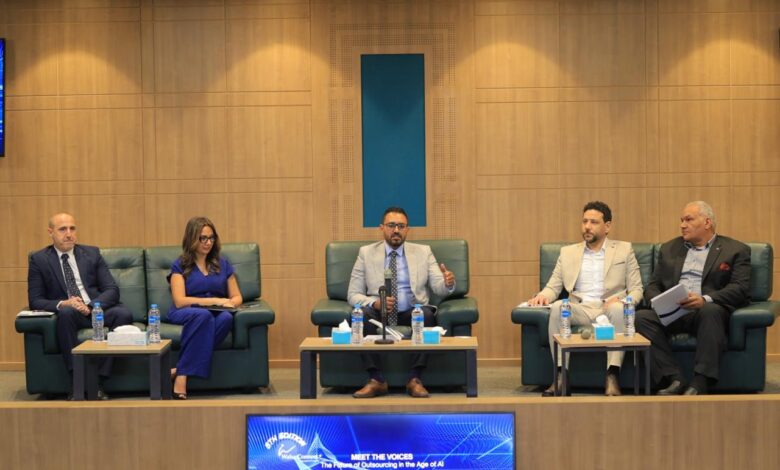
These critical issues were the focus of a panel discussion titled “The Future of Outsourcing in the Age of AI,” moderated by Mohamed Alaa El-Din, Co-founder of the “Ta3heed” platform. The session was part of the fifth edition of “Waha Connect,” launched by Silicon Wahas for Technology Parks at the Bani Suef Technology Zone.
The session, held last Wednesday, featured a distinguished group of industry leaders, including Shaimaa Abdel Aziz, Founder and CEO of GoChat247; Said Riad, CEO of Sky CX; Mahmoud Salama, COO of Ora Communication; and Khaled Nimr, Head of Administration and Facilities Management at Ison Experience.
The event saw a high turnout of university students, contact center professionals, technology experts, government representatives, and entrepreneurs.
The discussion revolved around the radical shifts in the outsourcing sector and AI’s role in redefining business models, emphasizing that this technology does not pose a direct threat to jobs but rather represents a new stage in the industry’s evolution.
Shaimaa Abdel Aziz: Voice Services Will Endure Longer; An Opportunity to Reskill Talent
Shaimaa Abdel Aziz emphasized that while AI will impact various industries, the customer service sector will be the most affected due to its reliance on continuous customer interaction.
She explained that smart systems are now capable of handling basic tasks, such as responding to FAQs—tasks that previously consumed significant employee time and effort.
However, she stressed that certain human aspects remain irreplaceable, such as empathy and the ability to understand customer emotions.
These are skills where the human element, particularly the Egyptian employee, excels with an innate capacity for improvisation and human interaction that is difficult for machines to replicate.
She added that the full impact of AI on voice services might take longer compared to text-based services, granting companies a window to reskill their workforce and align their abilities with future requirements.
Said Riad: AI is a Natural Extension of the Outsourcing Evolution
Said Riad noted that AI represents a natural progression for the outsourcing sector, which has evolved from traditional call centers to a comprehensive Business Process Outsourcing (BPO) industry.
He pointed out that every phase of this evolution has been accompanied by changes in the nature of jobs and required skills.
Riad compared AI technology to software like “Excel,” describing it as a tool that enhances efficiency and aids in decision-making but cannot fully replace humans.
He asserted that the jobs most affected would be those relying on repetition and rote tasks, while new roles requiring higher analytical and creative skills will emerge.
Khaled Nimr: The Real Challenge is Organizational Mindset, Not Technology
Khaled Nimr highlighted that AI provides companies with unprecedented capabilities to analyze big data and build more accurate operational models, contributing to cost reduction and increased productivity.
However, he argued that the real challenge lies not in the technology itself but in the organizations’ ability to embrace change and shift the traditional mindset of their employees. Successful digital transformation, according to Nimr, requires genuine investment in training and skill development to match new tools, noting that resistance to change is one of the biggest obstacles to fully reaping the benefits of AI.
Mahmoud Salama: Smart Systems Support Employees in Real-Time
Mahmoud Salama presented a vision for what he termed the “Golden Equation” for the sector’s future, based on human-machine integration.
He explained that AI currently acts as a smart assistant, supporting employees by analyzing customer sentiment during calls in real-time.
It can alert an agent to dissatisfaction or tension and provide immediate suggestions to handle the situation, thereby enhancing service quality and the overall customer experience.
Strategic Conclusion: From “Selling” to Strategic Partnership
Participants concluded that competition in the outsourcing market is no longer solely based on cost reduction but increasingly on providing added value.
Technology is now used to analyze data and offer smart solutions that help companies improve performance and increase sales, transforming the relationship between service providers and clients into a long-term strategic partnership.
They identified three key pillars for success: The Human Element, Processes, and Technology. Humans remain the primary engine of development, while agile processes accommodate changes, and technology provides the tools for efficiency and innovation.
The consensus was that the customer service sector is at the threshold of a new era. While smart systems take over routine tasks, the human element will focus on providing added value through creativity, analysis, and human interaction.
This confirms that the future of the industry will not be built on replacement, but on the seamless integration of human talent and technology.