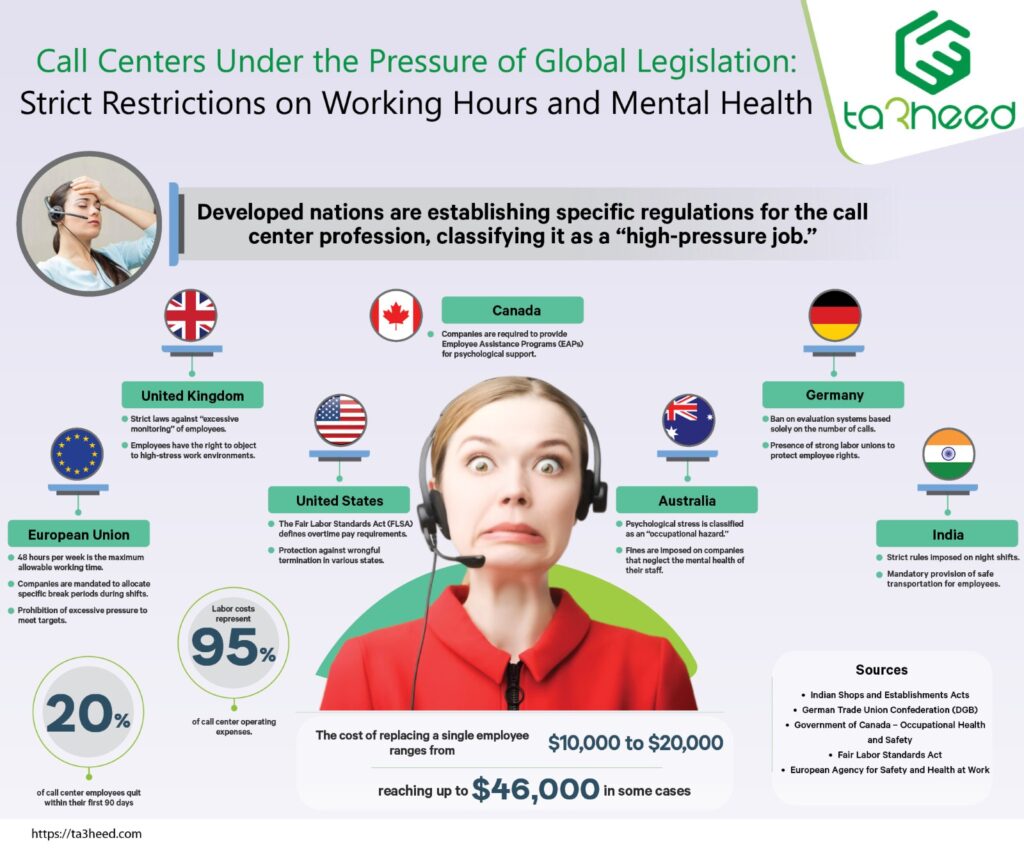


As the global call center industry continues to expand as one of the most labor-intensive and high-turnover sectors, developed nations are increasingly imposing regulatory frameworks that are reshaping the nature of work within this industry—which is formally classified as a “high-stress” occupation.
These legislations reveal a clear shift in how call center roles are perceived: transitioning from mere service-oriented jobs to work environments that require rigorous regulation to balance productivity with the mental and physical well-being of employees.
The European Union: A Focus on Occupational Safety
The European Union sets a clear regulatory framework for the call center profession, characterized by:
- Working Hour Caps: A maximum limit of 48 hours per week.
- Mandatory Breaks: Obligating companies to provide sufficient rest periods during shifts.
- Prohibiting High-Pressure Tactics: Banning management practices that lead to excessive stress to meet targets. These policies are rooted in a broader EU trend to enhance “workplace safety” as a fundamental component of public health.
The United Kingdom: Curbing Excessive Surveillance
In the UK market, laws are trending toward limiting rigid management styles within contact centers by:
- Criminalizing Excessive Monitoring: Restricting intrusive surveillance of employees.
- Employee Rights: Granting workers the right to contest high-pressure environments, part of a general movement to strengthen workers’ rights in labor-intensive sectors.
The United States: Fair Labor Standards
In the US, regulations such as the Fair Labor Standards Act (FLSA) govern the employer-employee relationship by:
- Overtime Guarantees: Ensuring fair compensation for additional hours worked.
- Relative Protections: Providing safeguards against arbitrary dismissal in certain states. While legislation varies by state, the general trend supports improving the work environment in high-pressure roles.
Canada: Human-Centric Support
Canada focuses on the human dimension of call center roles by:
- Mandatory Support Programs: Requiring companies to provide Employee Assistance Programs (EAPs). This reflects an official recognition that psychological stress in this sector is an inherent part of the work environment that must be managed.
Germany: Strict Evaluation Standards
German legislation is among the most stringent in Europe regarding worker protection.
Key features include:
- Balanced Evaluation: Prohibiting companies from relying solely on “call volume” as a performance metric.
- Union Influence: Labor unions play a powerful role in safeguarding employee rights and ensuring humane working conditions.
India: Safety and Operational Regulation
As one of the world’s largest outsourcing hubs, India’s legislation focuses on operational safety:
- Night Shift Regulation: Imposing specific rules for overnight operations.
- Mandatory Transportation: Obligating companies to provide safe transport for employees, addressing the challenges of work that extends beyond traditional hours.