

Daylight Saving Time: A Recurring Operational Challenge for Contact Centers in Egypt
The implementation of Daylight Saving Time (DST) in Egypt presents renewed operational challenges each year for the Business Process Outsourcing (BPO) and contact center sector.
This comes at a time when the industry is witnessing significant growth, solidifying Egypt’s position as a premier regional hub for cost-effective and high-efficiency digital services.
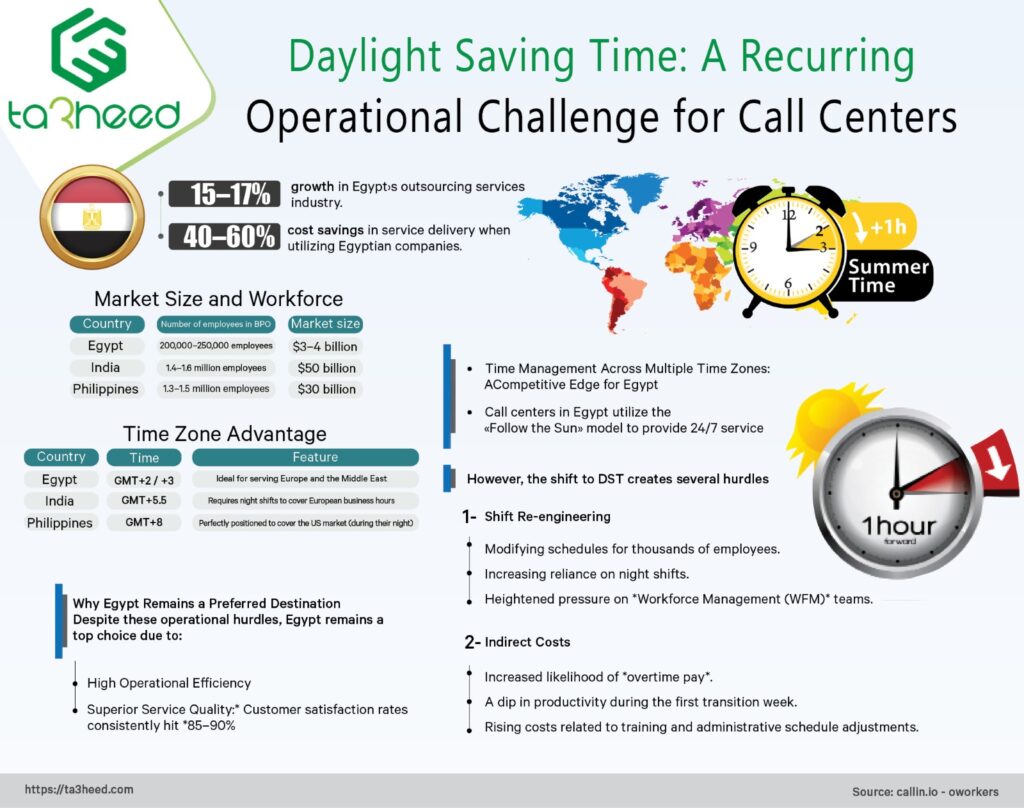
According to official data from the Ministry of Communications and Information Technology (MCIT), the outsourcing sector in Egypt is growing at an annual rate of 15% to 17%, driven by increasing global demand.
Egyptian companies offer substantial cost savings, ranging from 40% to 60% compared to traditional markets in Europe and North America.
While the total market size of Egypt’s BPO sector remains smaller than major Asian competitors, it maintains a distinct competitive edge based on low operational costs and high performance.
Currently, the sector employs between 200,000 and 250,000 professionals, with a market value estimated between $3 billion and $4 billion.
In comparison, the Indian market employs 1.4 to 1.6 million people with annual revenues exceeding $50 billion, while the Philippines employs 1.3 to 1.5 million people with a market size of $30 billion.
Geographic Time Zone: Egypt’s Strategic Advantage
Egypt possesses a critical temporal advantage, situated within the GMT+2 / GMT+3 range.
This positioning makes it ideal for serving European and Middle Eastern markets during standard business hours.
In contrast, India (GMT+5.5) relies heavily on night shifts to serve Europe, and the Philippines (GMT+8) is better suited for the U.S. market during its night hours.
This gives Egypt a competitive edge in operating real-time service models without the extreme operational pressure faced by other markets.
The “Follow the Sun” Model Under DST Pressure
Contact centers in Egypt utilize the global “Follow the Sun” operating model, which provides 24-hour customer support by distributing operational loads across different time zones. However, the application of DST imposes direct challenges on this model, most notably:
1. Workforce Re-engineering:
- Redesigning shifts for thousands of employees.
- Increased reliance on night-shift operations.
- Added pressure on Workforce Management (WFM) teams to maintain synchronization.
2. Indirect Operational Costs:
- Higher probability of overtime pay.
- Potential temporary decline in productivity during the first week of adjustment.
- Increased costs related to rescheduling and operational team training.
Furthermore, the time difference during certain periods necessitates working outside peak hours, which elevates operational costs due to additional wage requirements.