

Working mothers in the Business Process Outsourcing (BPO) sector manage their childcare responsibilities through a strategic mix of flexible solutions dictated by the industry’s unique nature.
The sector’s reliance on rotating shifts—including morning, evening, and graveyard shifts—to provide 24/7 support for global clients, alongside the recent expansion of hybrid and Work-from-Home (WFH) models, has made organizing childcare a complex daily challenge that varies significantly by region and corporate policy.
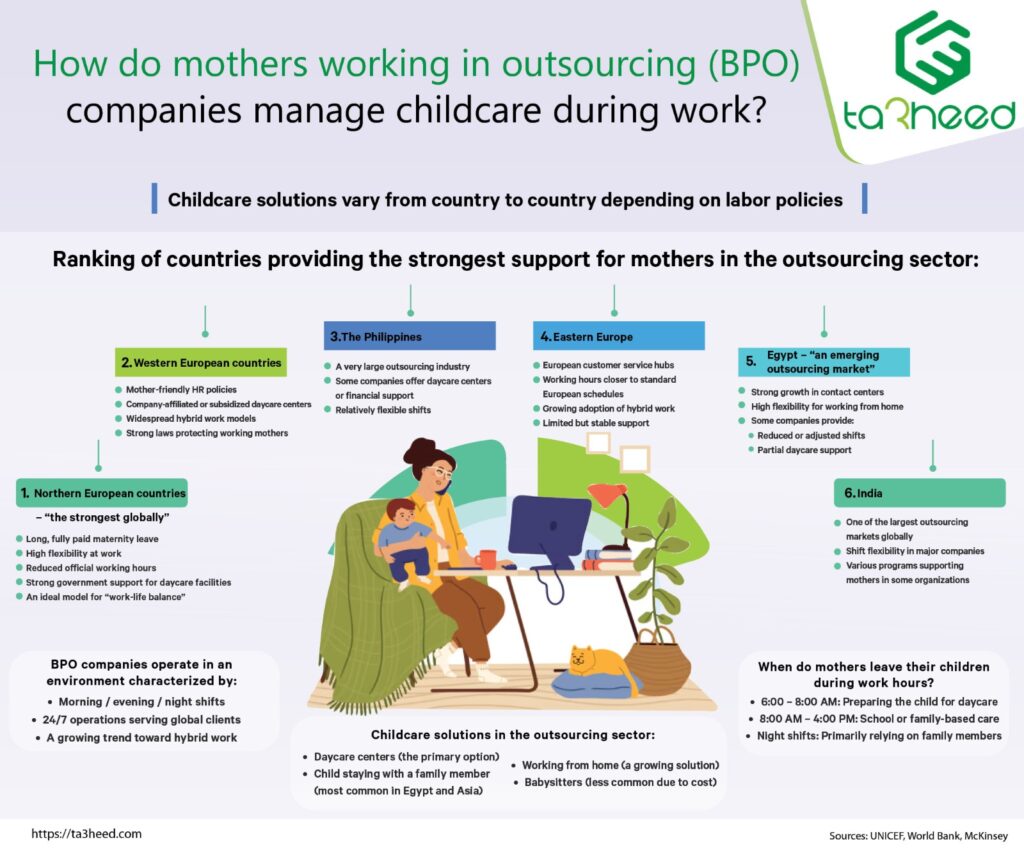
Global Perspectives on Maternal Support
- Northern Europe: Leading the global rankings, Nordic countries provide the highest level of support through long paid maternity leaves, significant flexibility in working hours, and robust government-funded nurseries.
- Western Europe: Followed closely by countries offering supportive HR policies, corporate-linked or subsidized childcare, and strong legal frameworks protecting the rights of working women.
- The Philippines: As a premier global BPO hub, many Filipino firms offer onsite nurseries or financial childcare assistance. However, the prevalence of night shifts due to time zone differences remains a primary hurdle.
- Eastern Europe: These regions benefit from servicing European markets with schedules closer to traditional business hours, though support levels are moderate compared to the West.
- Egypt: An emerging powerhouse in the BPO market, Egypt has seen a surge in WFH opportunities and relative shift flexibility in major firms. While some companies offer partial childcare support, the majority of working mothers still rely heavily on the extended family network.
- India: One of the world’s largest BPO markets, India offers flexible shifts in large corporations and specific maternal support programs, yet long hours and night shifts continue to pose significant challenges.
Childcare Routines and Daily Management
For BPO mothers, the day typically begins between 6:00 AM and 8:00 AM, preparing children for school or daycare.
During the day, children are usually in educational institutions or under the care of family members.
In the case of night shifts, the reliance on family becomes paramount, especially in societies where the extended family plays a central role.
Diverse Childcare Solutions
The industry sees a variety of solutions tailored to shift requirements:
- Nurseries: The primary choice for pre-school children.
- Family Care: The most prevalent solution in Egypt and Asia.
- Work-from-Home: An increasingly popular option that allows mothers to be physically present, though it demands high organizational skills.
- Nannies/Babysitters: A less common choice due to high costs.
The Path Forward
The ability of mothers to balance career demands with family responsibilities highlights the urgent need for more flexible corporate policies. Enhancing institutional support is not just a social necessity but a strategic move to ensure the stability and growth of the female workforce in this vital global sector.