


The “Digital Readiness Officer”: A New Paradigm for Change Management in Contact Centers
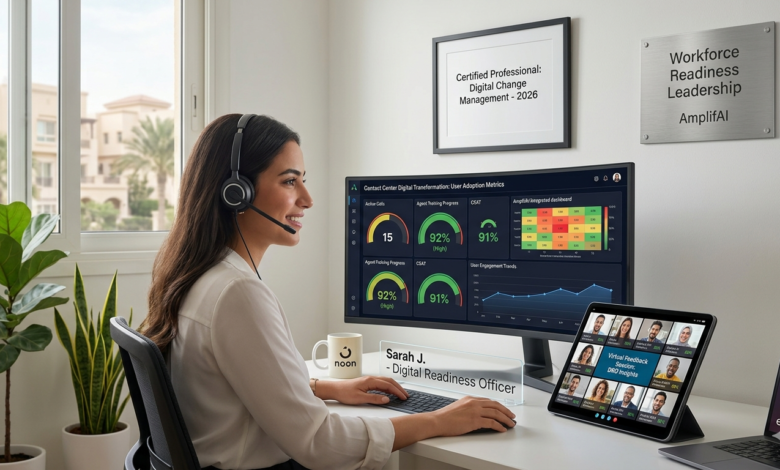
In an era of hyper-accelerated digital transformation, the primary challenge for organizations has shifted.
It is no longer merely about deploying cutting-edge technology, but rather about preparing the human element to navigate continuous change.
In this context, a pioneering model for managing transformation emerged at the international firm Simplyhealth.
The company introduced a new strategic role: the “Digital Readiness Officer” (DRO), specifically designed to anchor employees and facilitate their adaptation to an ever-evolving work environment.
Bridging the Gap Between Technical Execution and Human Adoption
The creation of the DRO role was a direct response to the scale and velocity of organizational shifts, particularly during major overhauls of workflow and customer service systems.
Management recognized that the success of these projects depended less on technical implementation and more on user adoption and the employees’ ability to utilize new tools effectively.
Consequently, change management was embedded into the core of daily operations rather than being treated as a separate, peripheral phase.
The Digital Readiness Officer became the architect of the entire change journey—from initial socialization and impact assessments to training, performance monitoring, and the continuous feedback loops required to refine the user experience.
Fostering Engagement and Overcoming Resistance
The role transcends simple communication; it focuses on building an interactive ecosystem where employees can voice concerns and contribute to the deployment strategy.
This participatory approach has proved vital in mitigating change resistance and significantly boosting engagement levels within operational teams.
Practical application revealed that the scope of these responsibilities often exceeds the capacity of a single individual, especially during enterprise-scale projects.
This led Simplyhealth to scale the function into specialized teams, ensuring employees receive adequate support and “buffer time” for experimentation and learning before new systems go live.
A Comprehensive Readiness Framework
Over time, this function has evolved into an integrated readiness system within the contact center. Key responsibilities now include:
- Impact Mapping: Identifying the nature, timing, and specific cohorts affected by changes.
- Curated Training Programs: Developing agile learning paths.
- Feedback Channels: Establishing persistent two-way communication streams.
- Readiness Metrics: Quantifying employee preparedness and engagement levels.
Results and Career Path Evolution
This strategic shift has yielded measurable success. Despite the intensity of recent transformations, the organization recorded its highest-ever Employee Engagement Scores.
This success highlights the model’s ability to balance technological advancement with human-centric needs.
Furthermore, the DRO role has carved out new career trajectories within the contact center.
It offers high-potential employees the opportunity to pivot into roles that blend organizational psychology with communication skills, supporting professional development and enhancing talent retention.
The Future: AI and Sustainable Transformation
As the industry braces for the further expansion of Artificial Intelligence (AI) and Automation, the reliance on Digital Readiness functions is expected to surge. Ensuring that a workforce is prepared—not just technically, but psychologically—is becoming the cornerstone of sustainable and effective digital transformation.